NCI - Neural Circuit Integration - is a clinician and neuroscientist-developed synthesis of EMDR, Attachment-Focused EMDR, IFS, TIST, Polyvagal Theory, somatic therapy, CBT, and mindfulness - organized around grounding, stabilizing, resourcing, and manifesting, with memory reconsolidation as the underlying mechanism. It is designed to integrate with existing modalities rather than replace them.
The protocol below summarises the framework and how the vitalme app supports between-session prep, practices, and consolidation.
NCI is not a treatment manual for any specific clinical condition, nor a substitute for clinician judgment. It is a neuroscience-informed organizing framework. Use of NCI does not modify standard-of-care obligations, informed-consent requirements, or clinical-safety protocols. The vitalme app is not FDA-cleared as a digital therapeutic; full Tier-2 prescription functionality is regulatory-gated.
Sequenced, but flexible.
NCI builds on Judith Herman's three-phase trauma model - safety and stabilisation, remembrance and mourning, reconnection - and extends it at the neural level to reflect what current neuroscience tells us about how trauma is held in the brain. The protocol is a logical sequence, but it is intended to be used flexibly: adapted, reordered, or selectively incorporated based on client readiness and clinician orientation. It is a set of recommendations designed to deepen the work clinicians are already doing - not a program that replaces it.
Foundation: intake, grounding, and the Life Navigator.
History-taking explores hopes, goals, strengths, and present-day residue rather than detailed trauma narratives - which reactivate amygdala-driven threat circuits and lower the metabolic threshold for re-experiencing. Pre-session optimization (sleep, nutrition, movement, environment) sets the conditions for neuroplasticity. In-session grounding - breath, interoceptive noticing, polyvagal state mapping, somatic-resource work - establishes the regulated baseline. From this baseline, the framework cultivates the Wise Self / Life Navigator: the regulated, observing presence with the metacognitive capacity to notice without merging.
Resourcing: building positive circuits.
The core innovation of NCI. Deliberate construction of the Resource Team - figures and places carrying the felt experience of safety, care, protection, perspective, play, repair, encouragement, compassion, and connection. Each resource is installed across as much of the cortex as possible - visual, auditory, kinaesthetic, interoceptive, emotional, cognitive - and amplified with the mass-cortical action induced by multi-sensory stimulation, so the positive circuit becomes strongly established enough to compete with the trauma circuit. Resourcing in NCI is not a stabilisation technique; it is active neural rewiring. See Resourcing below.
Reconsolidation and integration.
Present-day triggers serve as the doorway to underlying material - the trace-back technique (Shapiro, EMDR) - allowing experiences to surface within the regulated context the prior phases established. Imaginal repair offers the wounded part what it needed at the time, with MSS supporting reconsolidation as the memory is re-encoded with new emotional valence rather than reinforced. Neural Circuit Visualisation, Tour of the Adult Life, body scan, and sequential integration across the timeline extend the repair into broader neural networks - addressing residue stored in the somatosensory cortex and autonomic nervous system, and linking the reconsolidated memory across associative networks.
Manifestation.
Once trauma-based circuitry is weakened and new positive circuits are established, the same neural architecture is directed toward the life a client wants to create. The brain does not fully distinguish vividly imagined experience from lived experience - the mechanism by which imagined prospective neural templates become real and exert real counterbalance to traumatic and even looping mental habits.
Between-session reinforcement.
The neural changes initiated in session do not consolidate on their own. The vitalme app delivers the between-session arm - guided resource-figure meditations, somatic and breath practices, gratitude work, MSS calming scenes, sleep meditations, voice-described somatic awareness, a manifestation guide, and session-preparation tools.
Resource-figure taxonomy and installation.
Resourcing is the deliberate construction and strengthening of internal mental representations associated with positive affect, safety, and capability. Each resource is a constructed or recalled representation that, when activated with sufficient sensory richness and emotional engagement, fires the neural circuitry of the corresponding regulated state. Repeated activation strengthens the circuit; over time, it shifts the brain's default balance away from threat-detection and toward access.
The resource-figure taxonomy
Figures may be drawn from life, memory, imagination, nature, or spiritual experience - what matters is the felt quality they evoke, not their origin. Not all clients use all figures; the goal is to build the ones that work for that individual into reliably accessible circuits.
Location-based resource; activates parasympathetic regulation.
Attachment-system resource; activates safety and care-receipt circuits.
Defended-self resource; useful when external safety is compromised.
Perspective-taking resource; engages prefrontal regulation.
Restorative resource; supports daily repair.
Affirming, self-advocacy resource.
Play-system resource; lightness, delight, what knows how to play.
Gentleness, understanding, the meeting of pain without judgment.
Relational resource; activates oxytocin-mediated social bonding.
Installation
For each resource, NCI's multi-sensory prompting framework activates as much of the cortex as possible - visual, auditory, kinaesthetic, interoceptive, emotional, cognitive - while MSS reinforces the encoding.
The vitalme app provides personalized meditations built around each client's resources, with visual and auditory reinforcement.
MSS - bilateral stimulation, extended.
Multi-Sensory Stimulation extends EMDR's proven-effective bilateral-stimulation principle across visual, auditory, tactile, and interoceptive channels - supporting dual-attention and broader cortical engagement during resourcing and reconsolidation. The vitalme app delivers MSS as curated calming scenes for between-session use; client-led reconsolidation remains in-session under clinician supervision.
NCI is modality-agnostic by design.
A clinician working primarily in EMDR will recognize the bilateral-stimulation, AIP, and memory-reconsolidation framing - and find the resourcing protocols (drawn from Parnell and Teal) directly compatible. A clinician in IFS will find the parts-work compatibility immediate. A psychodynamic clinician can add nervous-system regulation and resourcing alongside interpretive practice, without altering the relational frame. A CBT clinician can add resource-figure installation and somatic regulation alongside cognitive restructuring without breaking protocol fidelity.
The framework's contribution is not novel technique but synthesis and depth - neuroscience-informed extensions to the modalities, woven through the protocol and the vitalme app, designed to increase neuroplasticity; the structured between-session integration; and the discipline of working with what trauma left behind rather than re-narrating what happened.
White paper.
The full NCI Framework — typeset for clinical use, with the new neuroscience of cortical information storage, the resource-figure taxonomy, MSS installation steps, the noticing prompts, and the between-session reinforcement model laid out end-to-end.
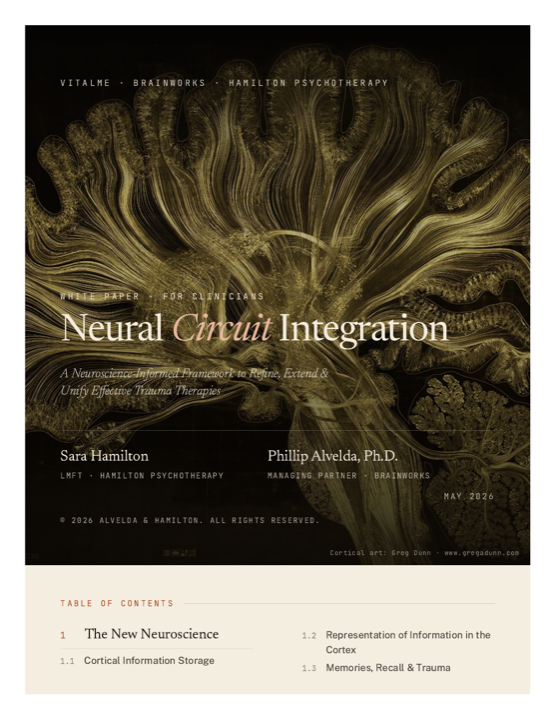
NCI Framework v1.0
A neuroscience-informed framework to refine, extend, and unify effective trauma therapies — synthesizing EMDR, IFS, Polyvagal, somatic, and mindfulness work around resourcing, memory reconsolidation, and Multi-Sensory Stimulation.
For licensed mental-health professionals. Not a substitute for clinical judgment, standard-of-care obligations, or informed-consent requirements. Request the full reference list →
Where the science comes from.
NCI isn't experimental. It's a synthesis of well-established clinical and neuroscience research. Some of the foundations it draws on:
- Shapiro, F. - Eye Movement Desensitization and Reprocessing (EMDR); Adaptive Information Processing model; bilateral stimulation; memory reconsolidation as underlying mechanism.
- Parnell, L. & Teal, A. - Attachment-Focused EMDR and Super Resourcing; imaginal resourcing and reparative experience for developmental and attachment wounds; progressive counterbalancing of trauma circuitry through positive circuit-building.
- Porges, S. - Polyvagal Theory; autonomic state hierarchy; social engagement system as the route to regulation.
- Schwartz, R. - Internal Family Systems (IFS); parts model; Self-leadership; protective function of parts.
- Fisher, J. - Trauma-Informed Stabilisation Treatment (TIST); resourcing-first discipline; stabilisation and self-compassion as the ground for deeper work.
- Ogden, P.; Levine, P.; van der Kolk, B. - Somatic approaches; Sensorimotor Psychotherapy; Somatic Experiencing; body-based memory; the body as a primary site of trauma and repair.
- Siegel, D. - Interpersonal Neurobiology; window of tolerance as the optimal arousal zone for new pattern learning; integration.
- Kabat-Zinn, J. - Mindfulness-Based Stress Reduction; metacognitive observation as the foundation of regulation.
- Memory reconsolidation literature - Nader, Schiller, Ecker, et al. - reactivated memories enter a labile state and can be re-encoded with new information when the nervous system is regulated.
- Dispenza, J. - Focused mental rehearsal and meditation as a route to psychological and physical change; foundation for the app's manifestation phase.
- Selected periodicals: NeuroImage; PMC 2024; PNAS; Journal of Traumatic Stress.
Full reference list and clinical-protocol documentation available on request: clinicians@vitalme.ai.